The Amplified Agentic Loop: Guardrails as Accelerators
Introduction
This article closes a trajectory started three posts ago. In See, Act, Correct, I described the three levers that turn a code agent from a gadget into a production tool, and introduced a grid to sort durable platform investments from temporary crutches. In Who does what?, I mapped the agentic organization onto Team Topologies. In Codifying the Rules, the enabling team baked its guardrails into the platform and vanished.
The trajectory is simple to state: to move from individual vibe coding (a developer “vibing” with their LLM) to industrialized, at-scale software engineering, the platform (in the Platform Engineering sense: an internal product that reduces the cognitive load of stream-aligned teams) must become the conductor of the agentic workforce.
Here is the problem this final part addresses. Today, all the control is concentrated at the beginning of the interaction, and the safety nets only react at the very end:
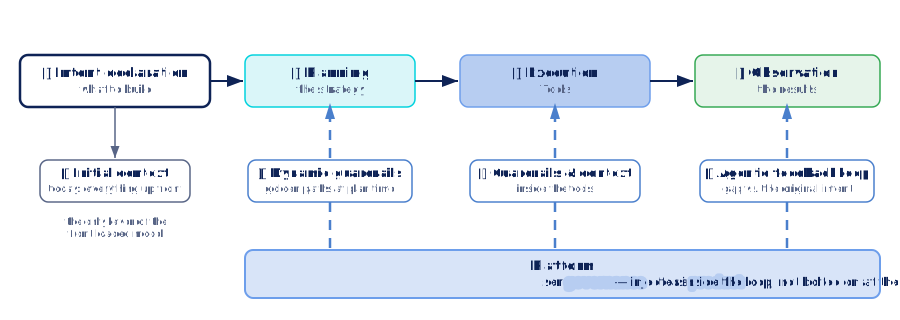
The left column is where today’s tooling operates: a heavy initial context, then nothing until a CI gate says “no”. The three blue channels are what this article designs: governance, architectural context, and safety served by the platform inside each step of the agentic loop.
Several tools already cover parts of this space. NeMo Guardrails distributes enforcement across input, dialog, execution, and output rails. POLARIS (January 2026) adds typed planning gates with policy-compiled guards. Agentic JWT (September 2025) proposes cryptographic action scopes that bind agent actions to user intent. Each addresses one phase. What is absent — and what a May 2026 survey on trustworthy agentic AI explicitly lists as an open challenge — is the integrated architecture: live architectural context at planning time, first-class capability tokens at execution time, and structured intent-gap feedback at observation time, combined into a single design where each phase amplifies the next. This article proposes one answer; the companion repository poc-agentic-platform is a working proof of concept, not a finished product.
The agentic loop, a reminder
The engine has not changed since the previous article: an agent captures an intent, plans the steps, acts through tools, and observes the results. When the observation is unsatisfactory, the agent re-plans and iterates: the loop is self-correcting.
This loop is the delivery engine of modern software. Everything that follows in this article is about one question: where does governance live in this loop?
The status quo: everything is front-loaded
Look at how we steer agents today. Governance rules, architecture context, security policies: everything is injected before the loop starts, through the initial prompt and global instruction files (CLAUDE.md, .cursorrules, copilot-instructions.md, system prompts). These files are the industry’s current answer to steering, and they share one property: they act once, at minute zero. The notebook on the diagram marks the spot: the initial context is assembled at Capture, once, and everything the stack dumps up-front lands in it.
The interaction is asymmetric: all the control is spent up-front. Once the loop starts spinning, the agent is on its own. Nothing guides it while it plans, while it executes, while it observes. We write two hundred lines of instructions and then hope.
The late gate: control after the work is done
The remaining control arrives at the worst possible moment: the end. The commit that breaks the CI is rejected. The forbidden API is flagged in code review. The non-compliant color ships to staging and bounces back.
These late gates do their job (nothing broken reaches production), but look at the cost. The agent has already burned its tokens. The work is done and must be redone. Each bounce is a full trip around the loop, plus a human interruption. This is the opposite of what the industry calls shift-left (moving verification as early as possible in the delivery process), and it frustrates the very flow the agent was supposed to accelerate.
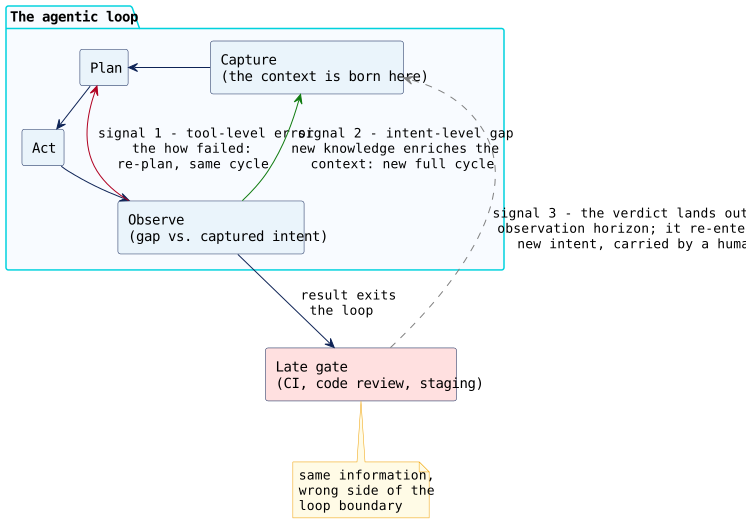
But wait: is self-correction not precisely the loop’s job? It is. The red arrow on the diagram has been doing exactly that since the first phase. The nuance is that the loop can only correct what its Observe step can see. The late gate delivers its verdict after the loop has exited, outside the agent’s observation horizon. So the rejection cannot be absorbed as one more iteration; it re-enters at the top, as a new intent, usually carried by a frustrated human. Same information, wrong side of the loop boundary.
The failure is architectural, not technical: the control exists, it is just in the wrong place. It sits outside the loop, when the loop is where the work happens.
The pivot: distribute governance inside the loop
Here is the shift this article proposes. Instead of concentrating everything at the start and controlling at the end, the platform injects governance inside each step of the loop:
- at planning time, the agent receives the architecture patterns, the critical dependencies, and the valid options, before it commits to a strategy;
- at execution time, the tools themselves carry the rules and validate state in real time;
- at observation time, the platform measures the gap between the result and the original intent and feeds it back, structured.
The initial context becomes light again: the intent, and little else. Everything the agent used to receive as a wall of up-front text is now delivered just in time, by the step that needs it.
Who builds this? The platform team, and this is Platform Engineering by the book: these mechanisms are designed, versioned, and served as internal products that stream-aligned teams and their agents consume without friction.
Pillar 1 — Amplified planning
Do not let the agent plan in the void. At the exact moment it designs its strategy, the platform provides the enterprise architecture patterns, the critical dependencies, and the valid options.
The industry has a name for the shape of this guidance: the Golden Path, the paved road, the supported and blessed way of building something, popularized by Spotify and productized by tools like Backstage. But today’s golden paths are documentation for humans. Here, they become a planning input for the agent: instead of discovering conventions by reading thousands of lines of code (or worse, by violating them), the agent receives the map of the terrain before it starts walking.
The nature of the guardrail changes: it guides toward the paved road at planning time, instead of saying “no” at the end.
Pillar 2 — Contextual in-tool execution
The tools the platform hands to the agent (CLIs, APIs, refactoring scripts) must not be passive executors that return exit 1 and a stack trace. They must be smart: encapsulate the business rules, validate state in real time, and, when something goes wrong, answer with an actionable, semantic error.
Compare the two experiences. A passive tool says:
Error: migration failed near line 12. SQLSTATE 42P07. Exit status 1.A smart platform tool says:
{
  "error_category": "DATABASE_SCHEMA_CONFLICT",
  "message": "Table 'payments' already exists in staging.",
  "remediation_guidance": {
    "allowed_actions": [
      "Use 'get_db_schema' to inspect the current structure.",
      "Add an 'IF NOT EXISTS' clause or rename the table."
    ],
    "context_update": "Current staging schema version: v2.4.1"
  }
}
The first output sends a weak model into a panic loop. The second one turns the failure into an immediate, guided self-correction: the tool behaves like a deterministic mentor.
Pillar 3 — Retroactive observation
Start with the question this phase usually raises: where does the observation get its yardstick? Not from a side channel; the loop does not need one. The context is born at Capture, and nowhere else. That is what the capture step is: the moment the loop’s working context is created and filled (the declared intent, the injected invariants). Every subsequent step appends to that same context: the plan, the tool calls, the raw results. By the time execution reaches Observation, the original intent is still sitting at the top of it. The context chip on the diagram shows exactly that: the yardstick flows from the captured context into the comparator, not from outside the loop.
Pillar 3 is about what observation does with that yardstick. It must not exist only to produce logs for humans. Its job is to measure the gap between the execution result and the captured intent, and to report it structured: which invariant was missed, by how much, what context changed. Not a raw “unsatisfactory result, try again”.
And observation does not complete the intent by itself; nor does an intent gap short-cut back to planning. None of this invents a new mechanism; it routes three existing signals to three different re-entry points. A tool-level error re-enters at Plan: a tool was called wrong, the how failed, re-plan the step within the same cycle (pillar 2). An intent-level gap is something else entirely: it is new knowledge (the measured gap, the facts discovered along the way), and knowledge belongs in the context. So it flows back to Capture, the context gains those new elements, and the loop runs another full cycle on the enriched context, until the gap closes or a budget guardrail fires. And the late gate of phase 3 re-enters nowhere: its verdict lands outside the loop’s sight entirely. The difference between the three is not the arrow; it is what the signal is, and where it gets to re-enter the loop. The intent is completed by cycling the loop; pillar 3 only sharpens the signal each cycle converges on.
(This pillar opens onto agentic telemetry: measuring guardrail efficiency across thousands of loop executions and feeding the next planning phases. That is the subject of a future article; the proof of concept below deliberately stops at pillars 1 and 2.)
The vision: guardrails as accelerators
Put the three pillars together and the paradigm has flipped. The platform validates the agent’s assumptions at every step, which gives it the confidence (the super-powers) to execute complex modifications safely. The result exits the loop already compliant: there is no gate at the exit because the gates did their work inside.
This is the philosophical core of the article: a well-placed guardrail is not a brake, it is an accelerator. Formula One cars corner faster because the track has barriers and the car has traction control. Remove them and every lap gets slower and more careful, not freer.
A fair objection at this point: “you have just described more scaffolding around the model — will any of it survive the next model generation?” That objection deserves a precise answer, and it needs a grid.
Two orthogonal axes: durable assets vs. scaffolding
In See, Act, Correct I introduced the distinction between compensatory systems, which work around the current limitations of a model and lose value as models improve, and amplifier systems, which build on the model’s strengths and gain value as models improve. The test is one question: would this artifact be more useful, or useless, if the model were twice as intelligent tomorrow?
Cross it with the implementation axis, declarative (text, simple, fragile) versus programmatic (code, deterministic, robust), and you get a two-by-two grid: compensatory versus amplifier, declarative versus programmatic. Read it as a decision tool, not a taxonomy: take the artifact you are about to build, ask the 2× question, route it into its column, and act on the verdict at the bottom (fund the right column; tag the left one and give it a sunset date).
The crucial insight, and the one I initially got wrong when designing what follows: whether a mechanism blocks or guides has nothing to do with whether it is compensatory or amplifying. A 200-line prompt enumerating forbidden files is guidance, and it is pure compensatory debt: it fights the model and rots as models improve. A hard gate that verifies a semantic invariant (“a schema migration precedes the code that uses it”) is a blocker, and it is a durable amplifier: a smarter model satisfies it more elegantly, and never makes it useless.
So the question for every platform investment below is never “does it constrain the agent?” but “does it age well?”. The bottom-right cell (programmatic amplifiers) is where the next three sections live.
Materializing Pillar 1: the Platform Planning Gateway
This is the first concrete proposal of this article. The Platform Planning Gateway (PPG) intercepts the planning step with two moves: one soft, one hard.
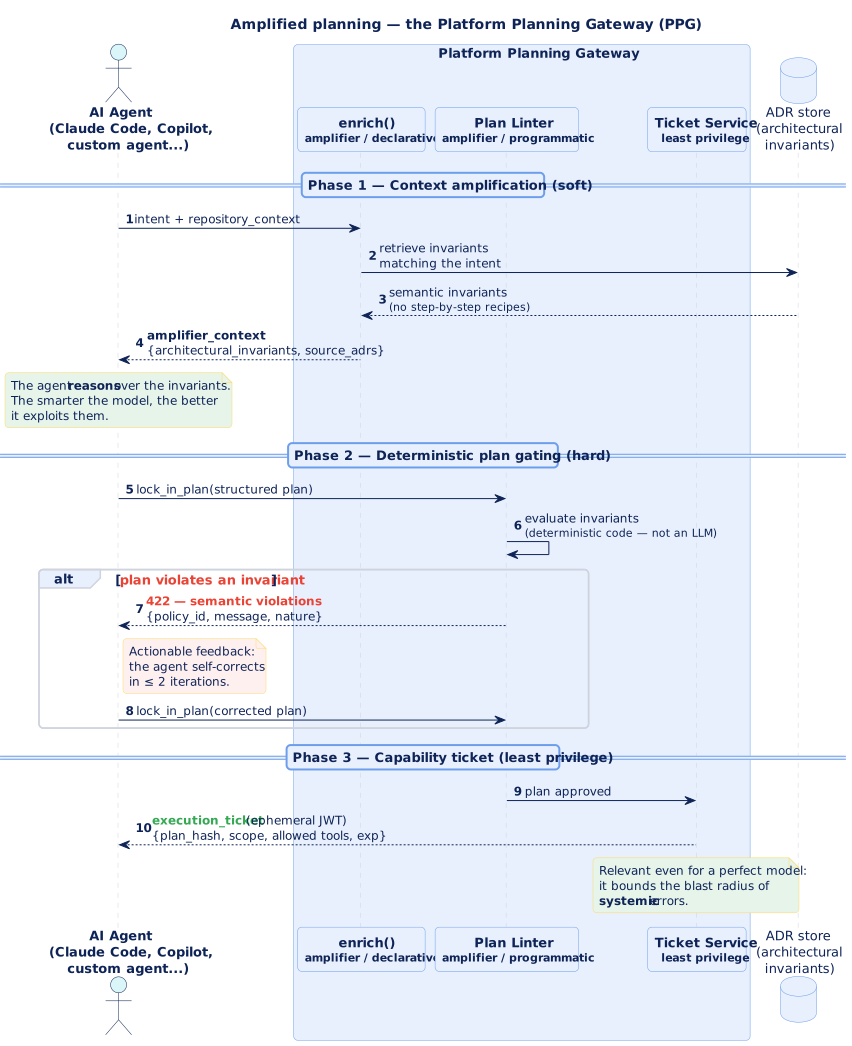
The soft move, enrich(): fetch the rules that apply, before planning. Think of the fifteen-minute conversation with the staff architect before you start a piece of work (“anything I should know before touching the payment code?”), automated. Before planning, the agent asks the platform exactly that question: it sends its intent and its repository context, and the gateway answers with the architectural invariants that apply, retrieved from the organization’s Architecture Decision Records. Concretely:
// agent → platform
{ "intent": "Add the Seka payment method to checkout",
  "repository_context": { "name": "checkout-service", "tech_stack": ["Go"] } }

// platform → agent
{ "amplifier_context": { "architectural_invariants": [ {
    "adr_id": "ADR-042",
    "invariant": "Every outbound call to a third-party service MUST go
                  through the corporate security egress proxy." } ] } }
How did the gateway know ADR-042 was relevant? Each ADR declares its own scope selectors (here, the keyword payment matched the intent): keyword matching in the PoC, semantic retrieval in production. The agent injects the returned invariants into its planning context and reasons over them: its plan now includes the proxy step before a single line is written.
Note the two things enrich() deliberately does not do. It does not enforce anything: it advises. Enforcement comes next, in the hard move. And it returns no recipe (“modify file X at line Y”), only semantic invariants: the recipes are exactly what a better model derives on its own. Architects write the invariants and the selectors in the ADRs; the gateway only retrieves. That division of labor is what makes enrich() a declarative amplifier: a smarter model exploits the same invariants better.
The hard move: lock_in_plan(). The agent must materialize its plan as a structured document (a JSON contract, not free text) and submit it. The gateway runs a plan linter using Open Policy Agent / Rego embedded in Go: deterministic code, deliberately not an LLM. A non-conforming plan is rejected 100% of the time, reproducibly, with semantic violations:
{
  "status": "PLAN_REJECTED",
  "violations": [{
    "policy_id": "go_tests_present",
    "message": "The plan must contain a 'go test' step for a Go stack.",
    "nature": "amplifier"
  }]
}
Each ADR with programmatic enforcement is a dual-representation governance artifact: it carries a semantic directive (the InvariantText Markdown body, injected at enrich() time into the agent’s planning context) and a paired .rego file (evaluated deterministically at lock_in_plan time by the OPA engine). The two representations serve different moments in the loop and can have different lifetimes on the durability axis: a semantic directive may be a permanent amplifier while the paired Rego policy is compensatory scaffolding scheduled for retirement. ADR-042 in the PoC is intentionally declarative-only — no .rego file — demonstrating that the architecture accommodates both modes.
The agent self-corrects, in practice in one or two iterations even with a small model: the linter redresses it like a compiler would.
When the plan passes, the gateway issues the capability ticket: an ephemeral signed JWT embedding the plan’s fingerprint and the least-privilege scope derived from it (which files may be modified, which tools may be called). This is capability-based security applied to the agentic loop, and it is the key that unlocks the next phase.
Materializing Pillar 2: Smart Tools honor the ticket
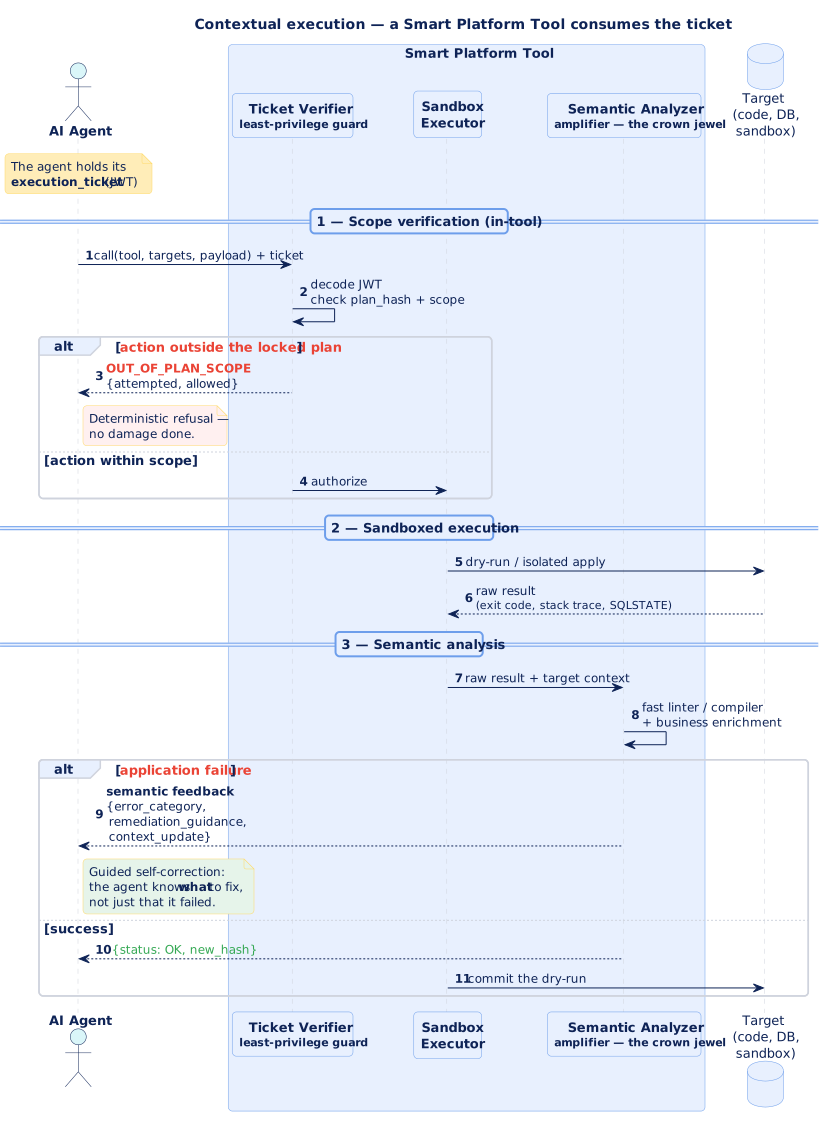
The ticket would be theater if the tools did not check it. So every Smart Platform Tool starts with the same three-step contract:
- Verify the ticket, in-tool. Agentic drift happens during execution: the agent decides mid-flight to touch a file it never planned to touch. The tool decodes the ticket, compares the requested action to the locked scope, and refuses deterministically:
OUT_OF_PLAN_SCOPE, nothing executed, no damage done, no cleanup. The check lives inside the tool because that is the last line of defense that no prompt drift can bypass. - Execute in a sandbox. Dry-run first, isolated copy, never directly on the target.
- Analyze semantically. On failure, the tool returns the structured, actionable payload from pillar 2: the error category, the remediation guidance, and the context the model cannot guess (the staging schema version, the interface definition, the violated ADR).
Note what the ticket refusal is not: it is not a punishment, and, matrix in hand, it is not compensatory. It addresses the symmetric risk of amplifiers: an ungoverned amplifier amplifies systemic errors at the same scale as successes. Least privilege stays relevant even against a perfect model, because it protects the organization, not the model.
Governing the transition debt
One piece is missing, and it is the one platform teams forget: the exit plan for the scaffolding.
Some of what we just built is compensatory, knowingly. The exhaustive enumeration of frozen legacy files exists because today’s models cannot reliably infer “deprecated, do not touch” from annotations. The raw-stack-trace-to-JSON translator exists because today’s models digest structured errors better than raw ones. Both will become dead weight as models improve — that is fine, if we can find them again.
So the proposal is to make the durability axis a first-class attribute of every rule: each policy, booster, and translator is tagged amplifier or compensatory, and every compensatory artifact must carry a measurable sunset condition (“model honors @deprecated semantically on >95% of our benchmark”). The platform exposes a transition-debt report: the compensatory ratio, and the list of pending sunsets. That ratio must trend toward zero across model generations: it is the health indicator of the platform investment.
For the record, the alternatives considered and rejected: putting everything in the system prompt (fragile, unverifiable, compensatory-declarative); gating only in CI (the late gate of phase 3: feedback arrives too late for self-correction); using an LLM to validate the plan (non-deterministic; we want a linter, not a judge).
The amplified loop, materialized
Here is the full picture, with everything in place.
The intent enters light. The plan is enriched by ADR invariants, linted deterministically, and locked into a capability ticket. The tools verify the ticket at their door, execute in sandboxes, and answer failures with semantic guidance. The observation measures the gap against the original intent and feeds the loop. Every artifact along the way is tagged on the durability axis, and the scaffolding has a scheduled exit.
The result flows out of the loop with no gate at the exit: not because control was removed, but because it was relocated to where the work happens. The stream-aligned team and its agents ship faster because the platform constrains them well.
Edit (July 10, 2026): The conceptual arc of this article ends here, and you can stop reading now. The sections below walk through the proof of concept, but two later articles do that job much better: Same Task, Two Endings shows the gateway in action on a single payment-integration story, with real replayable transcripts, and The Governed Skills Registry extends it to skill governance. If you only read one follow-up, read the first.
The proof of concept
Concepts about agent governance are cheap; deterministic behavior is not. The companion repository poc-agentic-platform implements pillars 1 and 2 end-to-end in Go: small enough to read in an evening, complete enough to run the whole cycle with curl.
One question the code answers clearly: how does the agent know what plan to submit to lock_in_plan? Three orthogonal layers:
| Layer | Source | Controls |
|---|---|---|
When to call lock_in_plan |
CLAUDE.md |
Behavioral rule |
| How to format the plan | MCP tool schema (auto-generated from plan.Plan) |
JSON structure |
| What the plan must contain | enrich() invariants |
Semantic content |
The schema validates structure deterministically; the linter validates ADR compliance deterministically; the model fills in the business content from the enriched context. None of the layers overlap. The full reasoning behind each design decision is in the repository’s explanation.
The planning side implements the sequence below: enrichment from a real ADR store (four ADRs with YAML front matter, including one deliberately tagged compensatory with its sunset condition), a deterministic plan linter, and JWT capability tickets:
The execution side implements the Smart Tool contract (in-tool ticket verification, sandboxed execution, semantic analysis):
Two details worth noticing in the code:
- The generic raw→JSON translator and the semantic enrichers are separate packages, because they sit in different cells of the matrix. The day models read raw stack traces natively, the first is deleted without touching the second.
- The debt report intentionally ships in
DEBT_ALERT(two compensatory artifacts out of five): the point of the mechanism is to be seen.
What it looks like in today’s tools
None of this requires a custom agent. The repository ships adapters that wire the gateway into off-the-shelf tools: a few lines of configuration, zero fork.
Claude Code, pillar 1: planning over MCP. The gateway is exposed as a stdio MCP server, built with the official Go SDK, with two tools. One command registers it:
claude mcp add ppg -- go run ./adapters/claudecode/mcpserverand one line in the project’s CLAUDE.md states the contract: “submit your structured plan through lock_in_plan before modifying anything.” From there, Claude Code calls get_platform_guidelines_for_intent natively, receives the ADR invariants, and locks its plan; on success the capability ticket lands in a .ppg-ticket file at the project root.
Claude Code, pillar 2: gating over hooks. This is the part I find most satisfying. Claude Code’s PreToolUse hooks provide exactly the in-tool interception point the Smart Tool contract requires. A ppg-guard binary is registered on every Edit|Write:
{ "hooks": { "PreToolUse": [ { "matcher": "Edit|Write",
    "hooks": [ { "type": "command", "command": "ppg-guard", "args": [] } ] } ] } }
The hook verifies the target file against the ticket scope. In scope: silent pass. Out of scope: the hook exits with code 2, which blocks the tool call before anything executes; the message on stderr is fed back to the model:
OUT_OF_PLAN_SCOPE: "internal/auth/login.go" is not part of the locked plan
(allowed: migrations/001_seka.sql, internal/payment/router.go, ...).
Nothing was modified. If this change is genuinely needed, re-plan through
lock_in_plan.
Read that message as the agent does: it is a deterministic refusal and a remediation path. In a live session, Claude reads it and either stays inside the locked plan or goes back through lock_in_plan: the drift is corrected by the loop itself, exactly as phase 11 of the diagram describes. An off-the-shelf agent, governed in-loop, without modifying a single line of the agent. The adapter README has the full setup.
GitHub Copilot: the black-box path. Copilot exposes no loop to intercept, so the adapter falls back to pre-flight context generation: go run ./adapters/preflight "add the Seka payment method" calls /enrich and writes the invariants into .github/copilot-instructions.md, which Copilot reads natively as repository custom instructions. The same governance reaches the black box, declaratively only. The honest caveat: without an interception point, hard gating cannot happen in-loop and must fall back to apply time (a pre-push platform check). That gap is the difference between an agent with an open loop and a closed one; it is a good criterion when choosing your tooling.
The documentation follows the Divio/Diátaxis documentation system (tutorial, how-to guides, reference, explanation), so the repository doubles as a template for documenting platform products. What the PoC would need to leave PoC status is listed in its explanation: embedding-based ADR retrieval instead of keywords, asymmetric keys behind a KMS instead of a hard-coded secret, a real copy-on-write sandbox, and the whole observation pillar.
How to judge whether such a gateway works in your organization? The success criteria I would track:
| Objective | Observable metric |
|---|---|
| Guidance before action | ADR invariants appear in the agent’s plan |
| Deterministic gating | A non-conforming plan is rejected 100% of the time |
| Actionable feedback | The agent corrects its plan in ≤ 2 iterations |
| Multi-tool portability | Works via MCP and via pre-flight instruction files |
| Traceability | Every locked plan is logged (hash + scope) before execution |
| Debt governance | Compensatory ratio decreases at each model upgrade |
Where this fits in the landscape
The table below maps the closest existing systems against the three phases. Columns mark genuine coverage, not aspirational claims.
| System | Planning-time context | Execution-time gating | Capability scopes | Semantic error returns |
|---|---|---|---|---|
| NeMo Guardrails | Dialog rails (scripted) | Execution rails (pre/post tool) | No | No (blocking/redirect) |
| POLARIS (Jan 2026) | Typed DAG + rubric gate | Compiled policy guards | No | Implicit only |
| Agentic JWT (Sep 2025) | No | Pre-execution scope enforcement | Yes (cryptographic) | No |
| Harnessing Embodied Agents (Apr 2026) | Capability admission | Runtime detection | Proto-tickets | No |
| This article | ADR invariants injected live | Capability ticket verified in-tool | Yes (governance-intent JWT) | Yes (structured, actionable) |
Two things in the bottom row have no column to the left of them in any existing system. First: the integration. Each of the four prior systems covers one phase; the mechanism that makes governance amplifying rather than merely present is the coherence across phases: the planning context shapes the ticket, the ticket constrains the tool, the tool’s semantic errors re-enter the plan. Second: the framing. Every existing system treats safety and productivity as a tradeoff to be managed. The claim here is different: a guardrail placed at the right phase of the loop removes friction rather than adding it, because the agent acts with more confidence, fewer late-gate surprises, and less rework. The trustworthy agentic AI survey frames the residual problem as a “trust-utility tradeoff”; the argument here is that the tradeoff is an artifact of placing the governance in the wrong place, not an inherent property of governance.
This remains a proof of concept. Keyword-based ADR retrieval would need embedding-based semantic search at scale. The JWT secret is symmetric and hard-coded. The sandbox is simulated. Pillar 3 (observation) is explicitly out of scope. None of that invalidates the architecture; it maps the production path. What the PoC demonstrates is that the three-phase integration is buildable with off-the-shelf components (Go, JWT, MCP) and composable with existing agents without forking them.
Conclusion
The thesis of this series, compressed into one sentence: the platform is the conductor of the agentic workforce, and its guardrails are the accelerator, not the brake.
The front-loaded model (a wall of instructions, then hope, then a late gate) treats the agent as something to be contained. The amplified model treats it as something to be equipped: the map at planning time, the rules inside the tools, the gap measurement at observation time. Same governance, relocated — and the relocation changes everything: feedback that arrives inside the loop costs one iteration; feedback that arrives after the loop costs the whole loop.
For the platform team deciding where to invest, the heuristic from See, Act, Correct remains the compass: will this be more useful, or useless, when the model is twice as intelligent? Fund the bottom-right cell of the matrix (plan linters of semantic invariants, capability tickets, semantic feedback), tag the rest as scaffolding, and give every piece of scaffolding a sunset date.
What remains open is the third pillar at scale: agentic telemetry, measuring across thousands of loop executions which guardrails amplify and which merely compensate, and feeding that back into the ADR store. That closing of the outer loop deserves its own article.
One side note for the future: the intent does not have to come from a human. It could arrive from another agent — an enterprise architect agent delegating a sub-task, a platform orchestrator breaking down a larger plan. That direction is where agent-to-agent protocols (A2A, AP2) come in; the governed loop described here becomes one node in a governed mesh.
Let’s make AI work on your machine in your organization — and let the platform hold the rails.